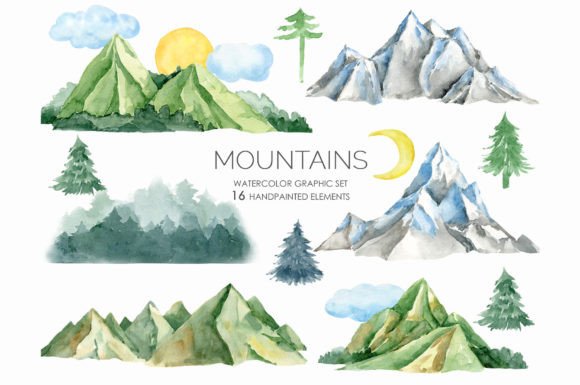
Evaluating Watercolor Forest Mountains Clipart for Creative Projects
In the realm of digital design, the choice of visual assets often dictates the tone and professionalism of a final product. The Watercolor Forest Mountains Clipart set represents a specific category of graphic resources designed to bring organic texture and artistic depth to various media. This collection includes 16 PNG elements featuring transparent backgrounds, rendered at a high quality of 300 DPI. These illustrations are hand-painted, offering a distinct aesthetic that differs significantly from vector-based or photographic imagery. For designers, crafters, and marketers, understanding the utility, limitations, and appropriate applications of this specific clipart set is essential before integrating it into a workflow.
Understanding the Asset Specifications
Before assessing the suitability of these graphics, it is necessary to define their technical characteristics. The core of this resource is its format: PNG files with transparent backgrounds. This transparency allows the images to be overlaid onto any color or texture without the distraction of a white box border, a critical feature for composite designs. The resolution is specified at 300 DPI (dots per inch), which is the industry standard for high-quality print production. Furthermore, the color mode is RGB, which is optimized for screen display but requires careful management when transitioning to print environments.
The content itself consists of 16 individual graphic elements depicting forest and mountain landscapes in a watercolor style. Unlike vector graphics, which use mathematical equations to create smooth lines that scale infinitely, watercolor clipart is raster-based. This means the image is composed of a fixed grid of pixels. While the 300 DPI resolution ensures sharpness at intended sizes, scaling these images beyond their original dimensions can result in pixelation. The "hand-painted" nature of the work introduces unique brush strokes, color bleeds, and textural variations that mimic traditional art supplies.
Primary Use Cases and Applications
The versatility of the Watercolor Forest Mountains Clipart makes it applicable across a wide spectrum of creative endeavors. Because the elements are isolated on transparent backgrounds, they serve as modular components that can be arranged, layered, and manipulated within design software.
- Print Media: The 300 DPI resolution makes these images suitable for physical products such as posters, stickers, and scrapbooking paper. The soft edges of watercolor blend well with other paper textures, enhancing the tactile feel of printed materials.
- Digital Design: In web design and social networking, these elements add a human touch that counters the sterile look of standard digital interfaces. They are effective for blog headers, website banners, and promotional posts where an artistic vibe is desired.
- Textile and Packaging: The repeating patterns possible with these forest and mountain motifs are ideal for the textile industry and product packaging. The organic shapes fit naturally on fabrics like cotton or linen, as well as on eco-friendly packaging for natural products.
- Event Projects and Branding: For events such as weddings, retreats, or outdoor festivals, these graphics provide a thematic backdrop. They can also be adapted for logos, particularly for brands associated with nature, wellness, or travel, provided the complexity of the watercolor texture does not obscure small details.
Benefits of Using Raster Watercolor Assets
The primary advantage of choosing this specific clipart set lies in its aesthetic authenticity. Vector illustrations of mountains and forests often appear too geometric or perfect. In contrast, hand-painted watercolor elements capture the unpredictability and fluidity of real paint. This adds emotional resonance and warmth to a project, making it feel more personal and less mass-produced.
Additionally, the inclusion of a transparent background streamlines the design process. Users do not need to spend time removing backgrounds using masking tools; the elements are ready for immediate placement. The high resolution ensures that when printed on mediums like stickers or posters, the image retains clarity and detail, avoiding the blurry appearance common with low-resolution web downloads.
Tradeoffs and Technical Considerations
While the benefits are clear, there are inherent tradeoffs to using raster-based watercolor clipart compared to other asset types. The most significant limitation is scalability. Since the images are fixed at 300 DPI, enlarging them significantly for large-format printing, such as billboards or huge wall murals, will degrade the image quality. Designers must calculate the maximum printable size based on the original pixel dimensions to ensure the output remains crisp.
Another consideration is the color mode. The files are provided in RGB (Red, Green, Blue), which is the standard for screens. However, professional printing typically uses CMYK (Cyan, Magenta, Yellow, Key/Black). When converting RGB watercolors to CMYK, certain vibrant hues may shift or appear duller than on screen. Designers should anticipate these color shifts and adjust expectations accordingly, especially if brand color accuracy is paramount.
Furthermore, the complexity of watercolor textures can sometimes interfere with legibility. If used as a background for text, the varying opacity and brush strokes might make reading difficult. It is often necessary to place a solid or semi-transparent shape between the text and the clipart to ensure readability.
When Alternatives May Be Preferable
Although the Watercolor Forest Mountains Clipart is robust for many scenarios, it is not the optimal choice for every situation. If a project requires extreme flexibility in sizing, such as creating a logo that must appear on both a business card and a building sign, vector graphics are superior. Vectors can be scaled infinitely without loss of quality, whereas these raster images have a hard limit.
Similarly, for projects requiring strict corporate identity adherence, the organic nature of watercolor might clash with rigid brand guidelines. Companies with minimalist, flat-design aesthetics may find the textured, blended edges of watercolor too busy or inconsistent with their visual language. In such cases, clean line art or solid-color vector icons would likely align better with the brand's goals.
Finally, if the end goal involves complex photo manipulation where the sky or background needs to change dynamically, these pre-rendered watercolor elements offer less control than layered PSD files or raw photographs. The painted nature of the mountains and trees locks them into a specific lighting and atmospheric condition, limiting the ability to alter the environment realistically.
Decision-Making Insights for Buyers
To determine if this set aligns with your specific needs, consider the following practical questions. First, what is the final output medium? If the primary use is digital or small-to-medium print runs (posters, stickers, packaging), the 300 DPI PNG format is highly effective. Second, does the project require an artistic, hand-crafted feel? If the answer is yes, the watercolor style provides value that vectors cannot replicate. Third, evaluate the required file formats. If you strictly need editable layers or CMYK-ready files out of the box, you may need to perform additional conversion work in post-production.
The download includes 16 distinct elements, providing enough variety for composition without overwhelming the user with excessive options. This balance allows for efficient workflow while maintaining creative freedom. By understanding the strengths of the transparent background and the limitations of the raster format, users can effectively integrate the Watercolor Forest Mountains Clipart into home and professional projects, ensuring the final result meets both aesthetic and technical standards.